Red Light vs. Near-Infrared Light: Which Wavelength Do I Need?
If you've spent more than ten minutes researching red light therapy, you've run into a version of this question. Panels list two numbers, 660nm and 850nm, and the marketing copy rarely explains the difference in plain terms. Here's the simple version.
What is Photobiomodulation
Photobiomodulation, or PBM, is the use of specific wavelengths of light, most often red or near-infrared, to trigger a response in cells. It can come from lasers or LEDs, and most research focuses on light in the red and near-infrared range.
They're different wavelengths of the same family
Red light (660nm) and near-infrared light (850nm) both fall into the range researchers study for photobiomodulation[1][2], the category of light therapy our RedRush panels deliver. They sit next to each other on the electromagnetic spectrum, just past visible red. Both are non-invasive and not UV. That's where the similarities end.
The practical difference comes down to depth. Red light at 660nm is visible, you'll see it as a warm glow when the panel runs, and it reaches the layers closer to the skin's surface. Near-infrared at 850nm is invisible to the eye and travels deeper. You can't see it, but your body can absorb it.
This is why most quality panels, including the RedRush 400 Pulse and the RedRush 840 Pulse, combine both. One wavelength isn't a substitute for the other.
Who typically reaches for each one
If skin appearance is your focus, red light is a natural starting point. The 660nm wavelength reaches the skin layers where surface characteristics like tone and texture reside. These are the same layers researchers focus on in photobiomodulation studies of skin.[3]
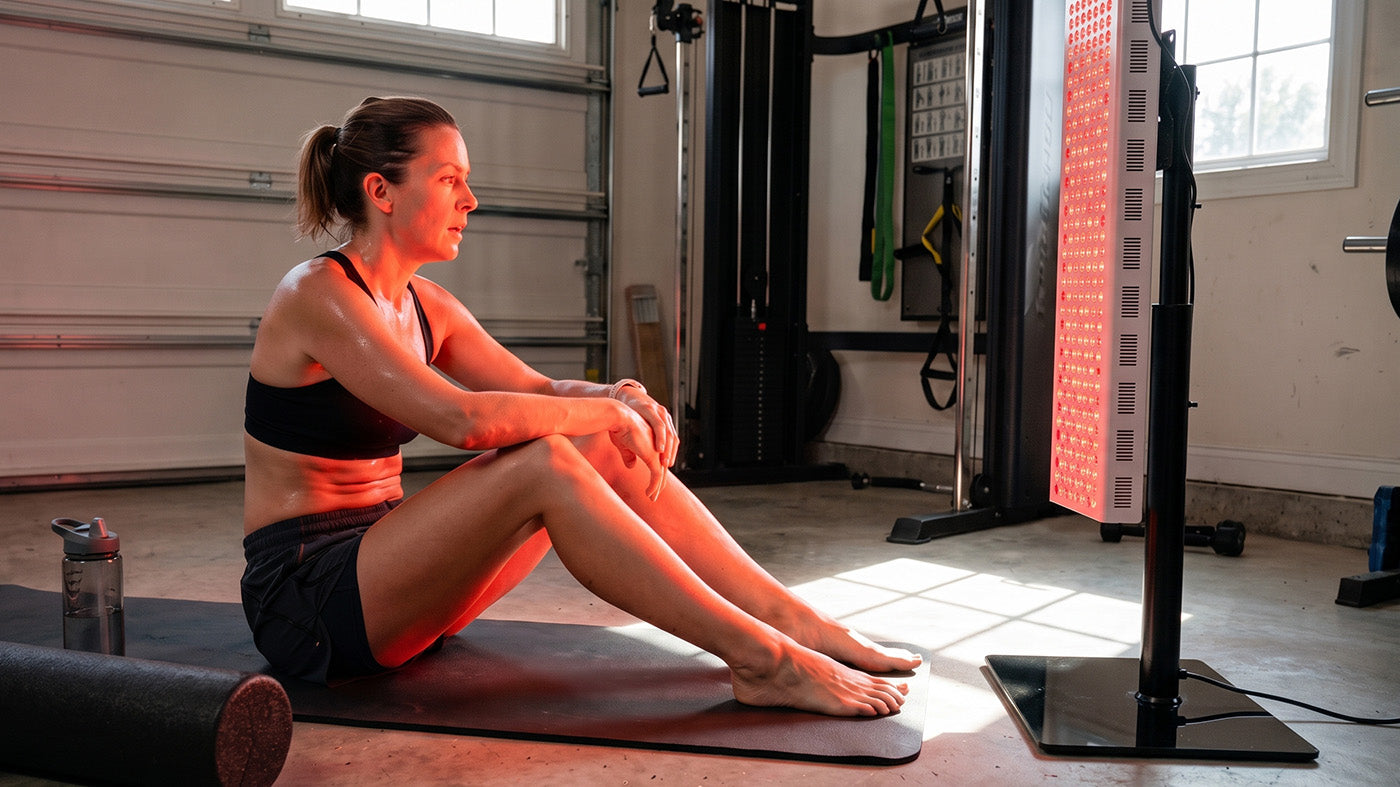
If your focus is on deeper tissue, muscle recovery after training, or a post-workout wind-down routine, near-infrared is the wavelength range researchers most commonly study for those goals. The 850nm NIR channel reaches past the skin surface into muscle and connective tissue, which is why it's the go-to for active recovery use.[4]Many athletes and active people who use the RedRush panels as part of a recovery routine reach for near-infrared, either on its own or alongside red.
For a general wellness routine, most people run both wavelengths together. Our RedRush panels let you activate red, near-infrared, or both simultaneously, so the most common session is simply both on at once.
One thing worth knowing: because near-infrared is invisible, a panel running only 850nm can look like it's off or only half-lit. It's working. Your eyes just can't see that part of the spectrum.
How the RedRush panels handle this
Both the RedRush 400 Pulse and the RedRush 840 Pulse run 660nm red and 850nm near-infrared LEDs in a 1:1 ratio — 67 red and 66 NIR in the 400, 140 of each in the 840. You control them independently via the touch buttons marked R for red and N for near infrared, so you can run one, the other, or both together in a single session.
The short answer on Red Light vs. Near-Infrared Light
You probably want both. RedRush panels run 660nm and 850nm simultaneously. Researchers study red light for skin-level goals and near-infrared for muscle recovery and post-workout use. Running both wavelengths covers more tissue depth in a single session. The RedRush panels are designed so you don't have to choose, but if you want to focus a session, the independent controls are there.
Start with both, use clean dry skin, begin farther away and at shorter times than you think you need, and build from there. Consistent use over several weeks is generally how people approach a skin-focused routine before drawing conclusions, though individual experiences will vary.
A note on the research
Both wavelengths are studied in the photobiomodulation literature. The research is ongoing and the evidence varies by application. RedRush presents these as general wellness tools, and nothing in this post should be read as a claim that either wavelength treats, cures, or prevents any condition. RedRush panels are marketed as general wellness products consistent with FDA's General Wellness policy guidance because they're designed to support healthy habits, not to substitute for medical care.
If you have a medical condition, take photosensitizing medications, are pregnant or nursing, or have any uncertainty about whether red light therapy is right for you, check with a qualified healthcare professional before you start.
For educational purposes only. Not medical advice. RedRush panels are general wellness products not intended to diagnose, treat, cure, or prevent any disease. Individual experiences vary. Results are not guaranteed. For questions about your specific situation, consult a qualified healthcare professional.
Reference List
- Hamblin MR. Mechanisms and applications of the anti-inflammatory effects of photobiomodulation. AIMS Biophysics. 2017;4(3):337–361. doi:10.3934/biophy.2017.3.337. PMCID: PMC5523874.
- de Freitas LF, Hamblin MR. Proposed mechanisms of photobiomodulation or low-level light therapy. IEEE J Sel Top Quantum Electron. 2016;22(3):348–364. doi:10.1109/JSTQE.2016.2561201. PMCID: PMC4846827.
- Avci P, Gupta A, Sadasivam M, Vecchio D, Pam Z, Pam N, Hamblin MR. Low-level laser (light) therapy (LLLT) in skin: stimulating, healing, restoring. Semin Cutan Med Surg. 2013;32(1):41–52. doi:10.1016/j.sder.2013.05.003. PMID: 24049929. PMCID: PMC4126803.
- Vanin AA, Verhagen E, Barboza SD, Costa LOP, Leal-Junior ECP. Photobiomodulation therapy for the improvement of muscular performance and reduction of muscular fatigue associated with exercise in healthy people: a systematic review and meta-analysis. Lasers Med Sci. 2018;33(1):181–214. doi:10.1007/s10103-017-2368-6. PMID: 29090398.